
Our Blog
A New Porthole to the Oceans
**This blog entry orginally appeared on the website oceanspaces.org.**/p> This post first appeared January 27, 2014 in the West Coast Governors' Alliance on Ocean Health, The Collaborative Voice of the West Coast Sea Grant Fellows.As someone working extensively with...
Getting Serious About the Ocean’s Invisible Threat
**This blog entry orginally appeared on the website oceanspaces.org.**/p> This post first appeared February 4, 2014 in The California Majority Report.Liz WhitemanMany factors influence the health of the ocean, but one making waves of late is ocean acidification. It is...
What is a ‘boundary organization’ and why should you care? — Part 1
**This blog entry orginally appeared on the website oceanspaces.org.**/p> This post is the first of a two-part series on the roles that boundary organizations play in linking science with decision making. Click here to view part two.There’s so much that scientists can...
What is a ‘boundary organization’ and why should you care? — Part 2
**This blog entry orginally appeared on the website oceanspaces.org.**/p> This post is the second of a two-part series on the roles that boundary organizations play in linking science with decision making. It was first published on January 24, 2014 in Leopold...
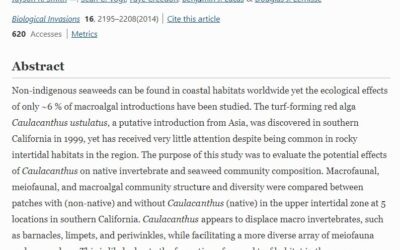
The non-native turf-forming alga Caulacanthus ustulatus displaces space-occupants but increases diversity
Smith, J.R., Vogt, S., Creedon, F., Lucas, B.J., and Eernisse, D.J. 2014. Biological Invasions. 16:2195-2208.
Focusing In: Long Term Monitoring Program and Experiential Training for Students
**This blog entry orginally appeared on the website oceanspaces.org.**/p> This is the first in a series of longer articles profiling the citizen science programs of the Central Coast based on our research efforts (see the introduction here). Stay tuned for others as...
Focusing In: Program Profiles of Central Coast Citizen Science
**This blog entry orginally appeared on the website oceanspaces.org.**/p> We’ve reached a turning point in our citizen science blogging experiment on Facing West. Until now we’ve been exploring, here in these virtual pages, a wide range of topics relevant to the...
North Coast MPA Baseline Program Launches!
**This blog entry orginally appeared on the website oceanspaces.org.**/p> Scientists, fishermen, tribal governments, and citizen groups from 30 organizations across eleven projects will work together to develop a baseline of ocean conditions and human uses in the...
What is the role of peer-reviewed literature in citizen science?
**This blog entry orginally appeared on the website oceanspaces.org.**/p> Professional scientists sit at the helm of some citizen science groups. For these groups, the scientific process exemplified is one very similar to a laboratory at a university. Lots of people...
Goin’ Fishin’: Scientists, Anglers and Charter Boat Captains are Teaming Up on Collaborative Fisheries Research Project
**This blog entry orginally appeared on the website oceanspaces.org.**/p> Due to a long history of perceived competing interests, recreational fishermen, academics, scientists and charter boat captains aren’t necessarily known for working well together. So how do you...
Good Science and Bad Science in Democratized Science
**This blog entry orginally appeared on the website oceanspaces.org.**/p> A common complaint about the increasing reliance on citizen science to understand our changing environment is that the information collected will not be as rigorous as from professional data and...
The Elders of Citizen Science
**This blog entry orginally appeared on the website oceanspaces.org.**/p> Depending on the strain of citizen science, people point to cooperative weather observing, water quality, or birds as 'the oldest'. Each arose in the cultural context of their time and...